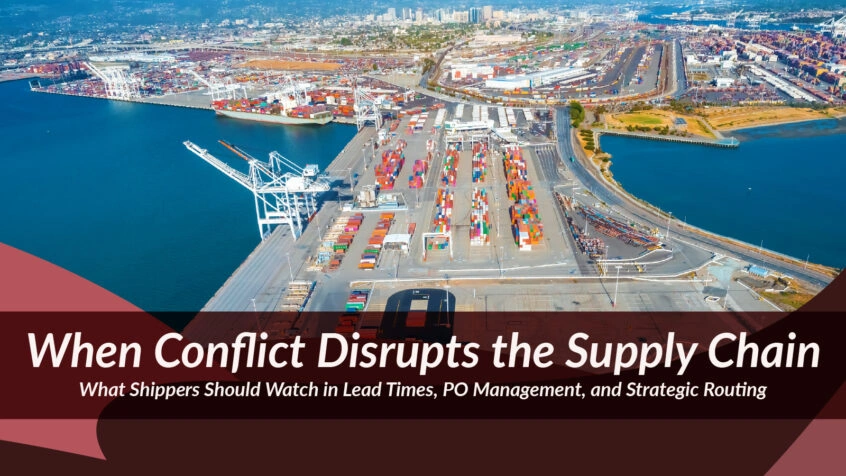
What Shippers Should Watch in Lead Times, PO Management, and Strategic Routing
Geopolitical conflict is often discussed in terms of headlines, oil prices, or market reactions. For importers, exporters, and logistics teams, however, the real impact shows up somewhere more immediate: in lead times that stop behaving predictably, purchase orders that require constant reprioritization, and routing decisions that suddenly carry far greater operational and financial risk.
Supply chain leaders should view the current conflict involving Iran, the United States, and the broader Middle East through an operational lens, one focused on planning risk, cargo flow, and service continuity. This is not only an energy story. It is also a planning story, a cargo-flow story, and, for many companies, an emerging service-risk story.
When a critical trade chokepoint is disrupted, supply chains do not simply become more expensive. They become less certain. That loss of certainty is often what creates the greatest pressure across procurement, transportation, inventory, and customer commitments.
Why This Matters Beyond the News Cycle
The Strait of Hormuz has long been one of the most important transit points in global trade, carrying roughly one-fifth of global oil consumption. When movement through the region is disrupted, the impact extends beyond oil and fuel. Carriers adjust services. Ports outside the primary lane absorb overflow. Alternative routings become crowded. Insurance costs rise. Air capacity tightens. Inland trucking demand increases. All of it filters back to the shipper in the form of delay, cost, and decision-making pressure.
For logistics leaders, the takeaway is clear: disruption in this region can quickly affect cargo planning far beyond the Middle East itself. Even companies with no direct Gulf destination exposure may still feel the effects through equipment imbalances, surcharge volatility, carrier schedule changes, and pressure on adjacent trade lanes.
Lead Times Are No Longer Fixed Assumptions
One of the first casualties of geopolitical disruption is lead-time reliability.
Under normal conditions, shippers build planning models around expected transit windows. There is always some variability, but operations can usually tolerate it. In a conflict environment, that assumption breaks down. Vessels may remain in safe waters. Port calls may change. Cargo may be diverted to contingency ports. Onward transport may require road or rail recovery. Shipments that once moved through one predictable routing can suddenly require multiple handoffs.
This is where companies get caught off guard. The issue is not always that every shipment stops moving. It is that transit times become uneven and harder to forecast. A purchase order expected to arrive within a familiar range may now face added dwell time, transshipment delay, port congestion, documentation complications, or inland recovery delays.
That kind of variability creates operational consequences quickly. Production schedules can slip. Distribution plans may need to be adjusted. Customer delivery commitments become harder to protect. Teams spend more time managing exceptions and less time executing against plan.
For that reason, this moment calls for a shift in mindset. Lead times should not be treated as static numbers. They should be treated as risk ranges. Companies that continue planning with pre-disruption assumptions may find themselves reacting too late.
PO Management Now Requires Prioritization, Not Routine Execution
In volatile periods, purchase-order management becomes a strategic function.
Not every PO should be treated the same. When freight costs rise, insurance premiums increase, and transit reliability weakens, the most resilient organizations are not the ones trying to move everything at once. They are the ones making faster, clearer decisions about what matters most.
That means asking practical questions about revenue impact, customer commitments, service sensitivity, and timing. Which POs are most critical to revenue? Which SKUs are most sensitive from a service perspective? Which shipments can tolerate delay without creating downstream disruption? Which cargoes should remain at origin until routing stabilizes? Which items no longer make economic sense to expedite under current conditions?
This is where visibility matters. Teams need enough supply chain insight to separate urgent shipments from non-urgent ones, protect high-value or high-service-impact flows, and avoid spending premium freight dollars on cargo that does not justify the cost.
Internal alignment is just as essential. Procurement, transportation, operations, finance, and customer-facing teams all need to work from the same playbook. If logistics is operating with one set of priorities while commercial teams are promising another, disruption becomes much harder to control.
Strong PO management in moments like this is not about moving faster by default. It is about moving smarter, with clear prioritization, scenario planning, and realistic service expectations.
Strategic Routing Has Become a Competitive Advantage
In stable markets, routing often becomes routine. In unstable markets, routing becomes strategic.
As carriers suspend services, introduce contingency measures, or adjust calls to safer or more operationally feasible ports, shippers need to think beyond the original booking path. A lane that looked efficient two weeks ago may no longer be the best option today.
This is where strategic routing starts to separate prepared companies from reactive ones.
Alternative gateways may help preserve continuity, but they can also introduce new bottlenecks. Diversion ports can create inland trucking challenges. Smaller facilities may not have the same throughput as primary hubs. Documentation tied to one destination may need revision if cargo is redirected. Even when a shipment keeps moving, the path to final delivery may be more expensive, more fragmented, and more vulnerable to delay.
At the same time, mode selection becomes more complex. Some shippers may consider shifting urgent cargo to air, but air freight capacity can tighten quickly in a regional conflict, especially when airspace restrictions and fuel volatility are also in play. That means expedited options may exist, but not at the same cost, coverage, or predictability companies are used to.
Strategic routing today is not just about finding another port. It is about evaluating the full movement: origin, carrier options, transshipment risk, inland recovery, customs implications, cost exposure, and customer delivery impact.
The companies that navigate this best are usually the ones treating routing as a live planning exercise, not as a fixed transportation instruction.
What Shippers Should Be Doing Now
For logistics teams navigating the current environment, a few actions stand out. The pressure created by conflict-related disruption is not limited to one lane, one supplier, or one mode. It can ripple across planning cycles, service expectations, landed costs, and internal decision-making. That is why the right response is not only to react to individual delays as they happen, but to step back and make deliberate adjustments that improve resilience across the shipment journey.
First, review lead-time assumptions immediately. Do not rely on pre-conflict transit expectations for exposed lanes or connected trade corridors. Add planning buffers where needed.
Second, segment open purchase orders by business impact. Identify which shipments are critical to revenue, service, production continuity, or customer retention, and prioritize those first.
Third, speak with carriers and logistics partners early and often. In volatile conditions, the quality of information can matter as much as the quality of execution.
Fourth, evaluate alternate routings with the full journey in mind. Port diversion without inland planning is not a complete solution.
Fifth, align logistics and finance. Surcharges, storage, recovery transport, and contingency routing can change landed-cost assumptions quickly.
Finally, communicate early with internal stakeholders and customers where risk exists. In disruption, transparency often protects relationships better than overpromising.
Why This Matters for GLC Clients
At GLC, we understand that supply chain disruption is not solved by watching the news. It is solved by building practical response strategies around visibility, routing, execution, and speed of decision-making.
As a fully integrated partner across customs brokerage, freight forwarding, warehousing, and supply chain consulting, GLC helps clients navigate uncertainty with a more complete view of the shipment journey. When conditions shift, the priority is not only to move freight. It is to protect continuity, manage cost where possible, and adapt the plan before disruption becomes a larger business problem.
That may mean reassessing routing options, reviewing PO priorities, planning around customs coordination and inland recovery needs, or building more resilient execution around high-impact shipments. In moments like this, supply chain performance depends on more than transportation alone. It depends on coordination.
The current conflict is a reminder that global supply chains do not need a full stop to feel serious pressure. Sometimes all it takes is a chokepoint disruption, a schedule change, or a surge in contingency costs to expose weak assumptions.
The companies that respond best will not necessarily be the ones with the lowest-cost plan on paper. They will be the ones with the clearest visibility, the fastest alignment, and the flexibility to make better decisions while conditions are still changing.
That is where experienced logistics partners make the difference.
If your team is reviewing lead-time exposure, evaluating alternate routings, or reassessing purchase-order priorities in light of current market disruption, GLC is here to help.