
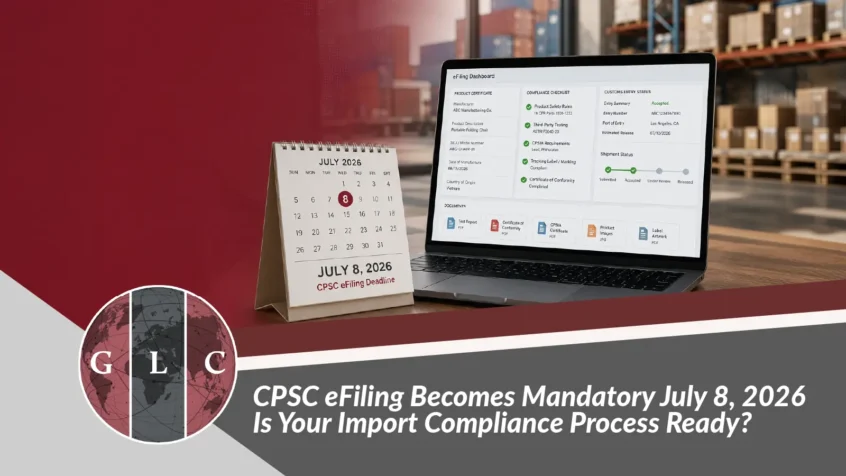
Beginning July 8, 2026, importers of regulated consumer products will face a major change in how product safety certificate information is submitted during the U.S. customs entry process. Under the U.S. Consumer Product Safety Commission’s new eFiling requirements, paper or PDF Certificates of Compliance will no longer be enough on their own for covered imported products.
Instead, required certificate data must be submitted electronically as part of the entry process. For importers, this is more than an administrative update. It is a documentation, compliance, and supply chain readiness issue that should be reviewed before cargo reaches the port.
Companies that import toys, children’s products, furniture, apparel, mattresses, bicycles, household goods, infant products, and other regulated consumer products should begin confirming whether their products require a certificate and whether their certificate data is ready for eFiling. For support coordinating customs entry requirements, GLC’s Customs Brokerage services can help importers prepare a more structured process before the deadline.
What Is Changing With CPSC eFiling?
CPSC’s eFiling program is designed to modernize how certificate data is submitted for imported consumer products that are subject to mandatory safety rules. Importers of covered products will need to electronically file certificate information at the time of entry, rather than relying only on certificates stored as paper or PDF documents.
According to the official CPSC eFiling program page, importers, brokers, and software providers should review their role-specific requirements and prepare ahead of full implementation. The rule applies to most regulated imported consumer products beginning July 8, 2026. Goods withdrawn from Foreign Trade Zones and entered into U.S. commerce will have a later effective date of January 8, 2027.
For companies managing international purchasing, freight movement, customs documentation, and U.S. distribution, this means certificate accuracy must be addressed earlier in the import cycle. A shipment may be physically ready to move, but if product certificate data is incomplete, outdated, or unavailable, the entry process can become more complicated.
Which Importers Are Affected?
The new requirements apply to imported consumer products that require either a Children’s Product Certificate (CPC) or a General Certificate of Conformity (GCC).
A Children’s Product Certificate is generally required for products intended primarily for children 12 years of age or younger and subject to a children’s product safety rule. These products typically require testing from a third-party, CPSC-accepted laboratory before certification.
Examples may include toys, children’s apparel, children’s furniture, cribs, strollers, high chairs, infant carriers, rattles, pacifiers, children’s sleepwear, and products regulated for small parts, lead, phthalates, magnets, or button cell batteries.
A General Certificate of Conformity applies to general-use consumer products subject to specific CPSC safety regulations. These products are not age-dependent. Examples may include bicycles, mattresses, carpets and rugs, wearing apparel, clothing storage units, garage door openers, multipurpose lighters, portable fuel containers, and certain products containing regulated components.
This distinction matters because some products may appear “ordinary” from a logistics perspective but still fall under CPSC rules because of their materials, components, intended use, or safety standard. Magnets, button cell batteries, lead-containing coatings, flammable fabrics, and children’s-use classifications can all change the compliance profile of an imported product.
What Information Must Be Ready for eFiling?
Importers should not wait until cargo is in transit to gather certificate information. CPSC eFiling requires structured data connected to each regulated product. This may include product identification details such as SKU, UPC, GTIN, or model number; the applicable consumer product safety rules; the party certifying compliance; manufacturing date and location; testing date and laboratory; and contact information for the individual maintaining testing records.
The CPSC Product Registry gives importers a place to store and manage certificate data that can support eFiling workflows. Importers should review whether each regulated product has complete, accurate, and reusable certificate data before shipments are booked or released.
For children’s products that require third-party testing, importers may also need to confirm that testing was completed through a CPSC-accepted laboratory. For companies with high SKU volume, seasonal product launches, or multiple suppliers, this review can quickly become a supply chain data management project.
Why Importers Should Treat This as a Supply Chain Readiness Issue
CPSC eFiling sits at the intersection of compliance, customs brokerage, freight timing, and product data management. If product certificate information is not ready at entry, delays may affect cargo release, downstream distribution, fulfillment timelines, and customer commitments.
This is especially important for importers in e-commerce, consumer packaged goods, household products, furniture, children’s products, and health and wellness categories. Many of these businesses operate with strict delivery windows, promotional calendars, marketplace requirements, and retail routing expectations. A documentation gap at entry can create operational pressure across the entire supply chain.
Importers should also coordinate eFiling preparation with broader transportation planning. If regulated cargo is moving through ocean freight, air freight, warehousing, or final-mile distribution, the documentation workflow should be aligned before the shipment moves. GLC’s Freight Forwarding services and Warehousing & Distribution services are designed to support importers that need logistics execution connected to customs visibility and documentation readiness.
Three Steps Importers Should Take Before July 8, 2026
First, determine whether your imported products are covered. Review your product catalog by SKU, supplier, material, component, intended user, and applicable safety rule. Products with children’s use, batteries, magnets, lead-containing coatings, flammability considerations, or other regulated features should receive priority review.
Second, establish your CPSC Product Registry process. Importers should create or access their Product Registry account, assign internal responsibility, and determine who will manage certificate data. The official CPSC eFiling Document Library includes guidance, FAQs, and training materials that can help businesses understand the registration and data entry process.
Third, align your broker, supplier, and logistics teams. Your customs broker can support the entry process, but the importer must have accurate product and certificate data available before the shipment arrives. Suppliers, testing partners, compliance teams, and logistics coordinators should all understand what information must be provided and when.
How GLC Can Support Importers
GLC, Inc. can support importers by helping coordinate the customs entry side of the eFiling process, provided the required certificate information is accurate and available before arrival. That preparation is critical. eFiling should not be treated as a last-minute document upload. It should become part of the importer’s standard pre-shipment checklist.
Through integrated customs brokerage, freight forwarding, warehousing, and supply chain support, GLC helps importers connect compliance requirements with real-world logistics execution. From reviewing entry workflows to coordinating cargo movement and release visibility, GLC works with importers to reduce avoidable friction and keep supply chains moving.
If your company imports regulated consumer products, now is the time to review your CPSC certificate data, confirm your Product Registry readiness, and prepare your customs process before the July 8, 2026 deadline.
Need support reviewing your import process for CPSC eFiling readiness? Contact GLC at [email protected] or connect with our team through the GLC Contact page.