
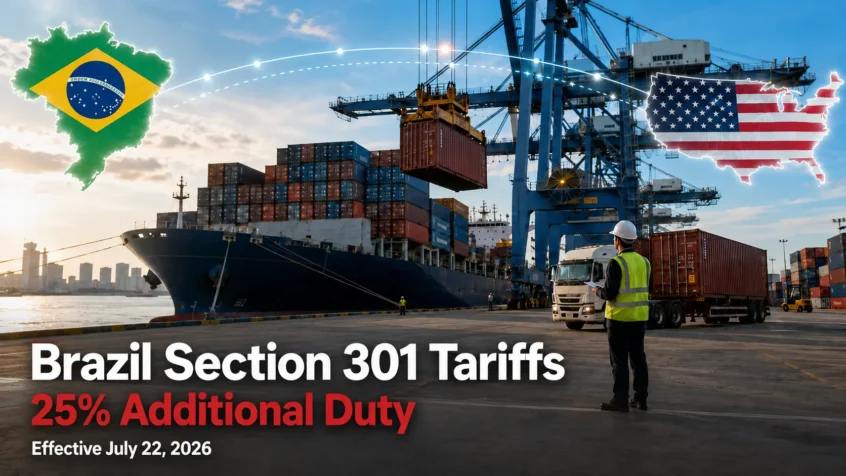
The Office of the United States Trade Representative has finalized a new Section 301 trade action affecting imports from Brazil. Beginning at 12:01 a.m. Eastern Time on July 22, 2026, covered products of Brazil entered for consumption, or withdrawn from a warehouse for consumption, will be subject to an additional 25% ad valorem duty.
For U.S. importers, the immediate question is not simply whether a shipment departed from Brazil. Companies must determine the product’s country of origin, confirm its Harmonized Tariff Schedule classification, review the official exclusions, and calculate the new duty within the total landed cost.
The measure may influence sourcing decisions, inventory timing, purchase agreements, pricing, and customs-entry procedures across multiple industries.
Why Did USTR Take Section 301 Action Against Brazil?
Section 301 of the Trade Act of 1974 authorizes the United States to respond to foreign acts, policies, or practices determined to be unreasonable or discriminatory and that burden or restrict U.S. commerce.
USTR initiated the Brazil investigation in July 2025. The investigation examined several areas, including digital trade restrictions, electronic payment services, preferential tariff treatment, anti-corruption enforcement, intellectual property protection, ethanol market access, and illegal deforestation.
According to the official USTR fact sheet, the agency concluded that certain Brazilian practices were actionable under Section 301. The final response is an additional 25% tariff on covered Brazilian-origin goods, intended to encourage changes in the practices identified through the investigation.
When Does the Additional Brazil Tariff Take Effect?
The additional duty applies to covered goods entered for consumption, or withdrawn from a warehouse for consumption, on or after 12:01 a.m. Eastern Time on July 22, 2026.
The principal Chapter 99 classification for covered merchandise is HTSUS 9903.05.01, which adds 25% to the duty already provided under the product’s ordinary tariff classification.
This means the Section 301 duty generally does not replace the product’s existing tariff. It is added to the applicable base duty and may interact with other fees or trade-remedy measures. Importers should therefore evaluate their complete duty exposure rather than focusing only on the new 25% rate.
Is There an In-Transit Exception?
The notice provides a narrow in-transit exception under HTSUS 9903.05.02. Merchandise may avoid the additional duty when both of the following conditions are met:
· The goods were loaded onto a vessel at the port of loading and were in transit on the final mode of transportation to the United States before 12:01 a.m. Eastern Time on July 22, 2026.
· The goods are entered for consumption, or withdrawn from a warehouse for consumption, before 12:01 a.m. Eastern Time on July 29, 2026.
Both requirements must be satisfied.
Importers should preserve bills of lading, loading records, arrival information, and entry documentation that support eligibility. A purchase-order date or booking confirmation alone may not establish that a shipment satisfies the specific language of the exception.
Which Brazilian Products Are Excluded?
The Section 301 action is broad, but it includes important exemptions. The notice excludes accompanied baggage, qualifying donations, informational materials, civil aircraft and related components, qualifying products for pharmaceutical applications, and categories covered by specified Section 232 measures. Annex II also identifies numerous product-specific exclusions based on HTSUS classifications.
USTR explained that exemptions were selected for reasons such as:
· Limited U.S. domestic supply
· The possibility of economy-wide disruption
· Difficulty obtaining the product from alternative sources
· A determination that applying the tariff would not materially advance the objectives of the Section 301 action
Examples referenced by USTR include certain pharmaceuticals and pharmaceutical ingredients, selected industrial raw materials, aluminum hydroxide, pig iron, specified scrap materials, organic honey, unflavored instant coffee, certain seafood and wood products, used clothing, antiques, and artwork.
However, descriptions provided in an article or summary are not a substitute for reviewing the precise tariff language. Importers should consult the official Notice of Action and annexes before determining whether a product is covered or excluded.
An importer should never assume that an exclusion applies based solely on a commercial product name. Eligibility may depend on the exact HTSUS subheading, material composition, technical specifications, intended use, or other conditions contained in U.S. Note 50 and the annexes.
What Should Importers Do Now?
Importers should begin with a complete inventory of active and planned imports of Brazilian origin. The review should include each product’s HTSUS classification, customs value, supplier, purchase order, expected entry date, port of entry, and current duty rate.
Next, companies should validate tariff classifications and country-of-origin determinations. The tariff applies to products of Brazil, so the place of export, invoicing entity, or transportation route does not necessarily determine exposure. Products incorporating Brazilian materials but manufactured in another country may require a separate origin analysis.
Every potentially applicable HTSUS classification should then be compared against the official exclusion provisions. The exemption list is highly detailed, and small differences in a product’s classification or use may change its treatment.
Importers should also recalculate landed costs. The analysis may need to include:
· The ordinary customs duty
· The additional Section 301 duty
· Freight and insurance
· Merchandise processing fees
· Brokerage and port-related charges
· Other applicable trade-remedy duties
Companies should review their purchasing terms and Incoterms® to determine which party is contractually responsible for additional duties.
Shipments already in transit, goods held in bonded warehouses, and merchandise entering foreign-trade zones require particular attention. The notice states that covered Brazilian products admitted into a U.S. foreign-trade zone generally must enter in privileged foreign status unless they qualify for domestic status.
Finally, importers should establish an ongoing monitoring process. USTR has stated that it will continue reviewing the measure and may consider modifications based on Brazil’s response and developments involving the practices under investigation.
How GLC Can Support Brazil-to-U.S. Importers
Rapid tariff changes require coordination among procurement, finance, logistics, suppliers, and customs teams.
Global Logistical Connections provides integrated customs brokerage, freight forwarding, warehousing, and supply chain support, connecting transportation execution with organized import-entry planning.
GLC’s Customs Brokerage services include customs-entry processing, Importer Security Filing coordination, classification support, bond management, duty-related processes, customs reporting, and communication through cargo release.
For companies reconsidering sourcing, routing, inventory placement, or cost models, GLC’s Supply Chain Consulting services can help evaluate operational alternatives, manage costs, and develop a more resilient import strategy.
The Bottom Line
The new Brazil Section 301 tariffs create an immediate customs-compliance and landed-cost challenge for U.S. importers.
The most important step is a product-by-product review: confirm Brazilian origin, validate the HTSUS classification, determine whether an exclusion applies, evaluate the in-transit rule, and update financial forecasts before entry.
Because the final notice contains detailed Chapter 99 instructions and extensive product exclusions, importers should rely on the official tariff language and qualified customs or legal guidance for shipment-specific decisions.
Proactive preparation can reduce entry errors, improve cost visibility, and help supply chain leaders respond to the new tariff environment with greater control.
Need support reviewing an upcoming import from Brazil? Contact Global Logistical Connections to discuss your customs brokerage and supply chain requirements.