

Court of International Trade: Unliquidated Entries Should Not Liquidate With IEEPA Duties (What Importers Should Do Now)
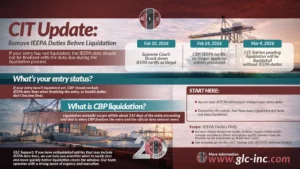
On March 4, 2026, the U.S. Court of International Trade (CIT) issued an order instructing the government to finalize the processing of goods entering the United States without assessing IEEPA-based tariffs, following the Supreme Court’s finding that IEEPA does not authorize these tariffs. Practically, this applies to entries where IEEPA duties would otherwise be assessed that are still unliquidated.
In plain terms: if your entry hasn’t liquidated yet, CBP should remove the IEEPA duty before liquidation, so those duties don’t get “locked in” as the final amount owed.
Note: This update focuses on IEEPA duties only. Other tariff programs (including Section 232 and Section 301) remain separate and are not automatically affected.
Quick refresher: What does “liquidation” mean?
In CBP language, liquidation is the final calculation of duties for an entry, essentially the moment CBP “closes the file” and confirms what was owed.
That’s why unliquidated entries matter right now: while an entry is still open, there’s a window to correct duty lines (including removing now-invalid IEEPA duties) before CBP finalizes the entry.
What the CIT order changes for importers
The key takeaway is operational: this isn’t just a headline, it changes what should happen inside CBP’s entry-processing workflow. If an entry is still open (unliquidated), CBP should exclude the IEEPA duty lines when it finalizes the entry, and importers should treat this as a time-sensitive window to review open entries and correct any IEEPA assessments before liquidation closes the door.
- For unliquidated entries: CBP should not liquidate your entry with IEEPA duties included.
- For supply chain teams: this is a trigger to identify open entries that include IEEPA tariff lines and coordinate corrections before liquidation.
This matters at scale: a significant number of entries may still be unliquidated at any given time, meaning the order could affect a large volume of shipments.
What this does not change
Even with the CIT order, importers should avoid assuming this is a blanket duty “reset.”
- IEEPA duties: the focus here.
- Other duties/tariffs: Section 232 (steel/aluminum/derivative products, autos/parts, etc.), Section 301, AD/CVD, MPF/HMF, and other programs have their own rules and remain in force unless separately modified.
What you should do now (practical steps)
1) Identify whether you paid IEEPA duties
Start with a data pull from your broker, ERP, or ACE reports. Look for:
- The IEEPA-related HTS tariff lines that were used to assess the additional duty
- Entry numbers, entry dates, and (most importantly) liquidation status
2) Split your entries into two groups
A) Unliquidated (still open)
- Priority group.
- These are the entries where you may be able to remove the IEEPA duty line before liquidation.
B) Liquidated (already finalized)
- Refund timing and process are still developing.
- Your recovery path may involve a combination of protests and/or litigation strategy depending on the final guidance.
3) If the entry is unliquidated: move early
For many importers, the first operational move is to work with their licensed broker on a pre-liquidation correction (often via Post Summary Correction / PSC).
Timing matters: correction windows can close quickly as an entry approaches liquidation.
4) If the entry is liquidated: preserve your options
If an entry is already liquidated, you generally have limited windows to challenge or recover duties.
- Confirm the liquidation date(s)
- Coordinate with your broker and trade counsel on whether a protest is appropriate
- Keep documentation organized (entry packets, duty calculations, invoices, proof of deposit)
5) Expect continued updates
Between court orders, agency messaging, and system changes, the operational guidance will likely keep evolving.
The best approach is to:
- Track new CBP messages
- Keep a live log of impacted entries
- Move on unliquidated entries first
How GLC can help
GLC is a U.S.-based freight forwarder and licensed Customs Brokerage partner, with hands-on support for ACE/ABI entry filing, HTS classification and tariff line review, and weekly monitoring + client alerts as guidance changes. That means we don’t just “file the entry”, we help you reduce landed-cost surprises, prevent delays, and keep your compliance clean, especially when tariff programs change quickly. Our team supports importers by coordinating documentation, classification strategy, and entry execution across brokers, carriers, and internal teams, including:
- Entry review + audit: identify which entries include IEEPA duty lines and whether they’re still unliquidated
- Pre-liquidation correction support: coordinate filings and data required to remove invalid duty lines before liquidation
- Documentation + compliance support: classification review, entry hygiene, and process alignment to reduce rework
- Ongoing monitoring: we’ll continue watching CBP guidance and court updates to help you adjust quickly
If you want help reviewing your entries or building an action plan, email us at [email protected].
Frequently asked questions
Does this mean I automatically get a refund?
Not necessarily. The CIT order is most actionable for unliquidated entries, where the duty line can be removed before CBP finalizes the entry. Refund mechanics for already-paid duties (especially on liquidated entries) may depend on additional guidance.
Does this affect Section 232 or Section 301?
No. This update is about IEEPA duties. Other tariff programs remain separate.
What’s the fastest next step for my team?
Pull a report of entries that include IEEPA duty lines and sort them by liquidation status and time-to-liquidation.
Disclaimer: This article is for general informational purposes and does not constitute legal advice. For legal strategy, consult qualified trade counsel.