
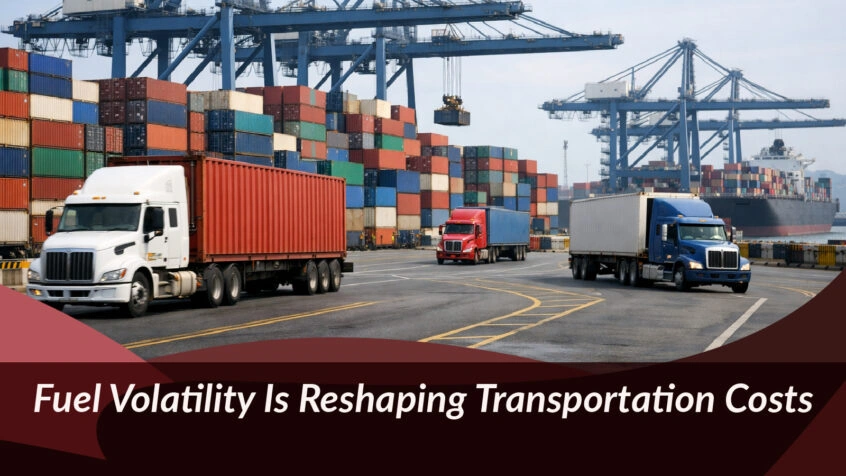
Fuel prices have always influenced transportation costs, but in the current market, the impact is becoming harder to ignore. For many shippers, the biggest challenge is not only that diesel is expensive. It is that diesel volatility is now flowing directly into weekly fuel surcharge adjustments, making logistics budgets more difficult to predict from one week to the next.
That matters because transportation spend is not driven by base rates alone. Even in a market where linehaul rates may feel relatively stable, fuel surcharge mechanisms can still push total costs upward. For importers, exporters, and supply chain teams, that means a shipment can become more expensive even when the underlying freight rate has not changed significantly.
In practical terms, this is where many businesses are feeling the pressure. Drayage moves may carry a percentage-based fuel surcharge, while OTR truckload shipments may carry a per-mile surcharge. In many parts of the market, both are tied to the DOE/EIA national diesel benchmark and updated on a weekly cadence. When diesel rises, those surcharges tend to rise with it. When diesel softens, they typically move down the same way. The structure is straightforward, but the operational impact can still be significant.
Why Fuel Matters So Much Right Now
As of March 17, 2026, the U.S. average diesel price stood at $5.07 per gallon, a reminder that fuel remains a live and immediate cost driver for shippers.
Diesel remains one of the most important cost drivers in freight transportation. It affects over-the-road trucking, drayage, port recovery, yard activity, and a wide range of domestic and cross-border moves. When the national diesel average rises, the impact can be felt quickly across the supply chain.
That is especially relevant in the current environment. Market disruption tied to conflict in the Middle East has placed renewed pressure on global energy flows, and diesel has become one of the most exposed products. For shippers, that means fuel volatility is no longer an abstract market signal. It is a direct logistics concern that can affect:
- Shipment pricing
- Planning assumptions
- Landed cost
- Weekly transportation budgets
This is also why fuel deserves separate attention from broader freight pricing discussions. A shipper may hear that the trucking market is still relatively soft, or that spot linehaul rates remain manageable, and assume transportation budgets are under control. In reality, the all-in cost picture can look very different once weekly fuel surcharges are layered in.
How Fuel Surcharges Work in Practice
Fuel surcharges are designed to create a transparent way to adjust transportation costs as diesel prices change. In many parts of the market, carriers and transportation providers use the DOE or EIA national diesel benchmark as the basis for those adjustments.
For truckload, the surcharge is often expressed as a per-mile amount, which makes it especially visible to shippers because it scales directly with distance and can materially change the all-in cost of longer-haul moves. That means the higher the diesel benchmark climbs, the more is added per mile to the shipment cost. In the current environment, an OTR truckload fuel surcharge of $0.73 per mile is not unusual. It reflects the reality of high diesel costs and allows that expense to be addressed through a structured pricing mechanism rather than absorbed unpredictably by the carrier.
Drayage moves may carry a percentage-based FSC, and OTR truckload shipments may carry a per-mile FSC, both commonly tied to the DOE/EIA national diesel benchmark and adjusted weekly.
In both cases, the key point is consistency. If the surcharge is tied to the DOE national fuel average and reset weekly, then shippers can at least understand the logic behind the number. They can track the benchmark, anticipate movement, and adjust budgets accordingly. The challenge, of course, is that when fuel remains volatile, those weekly resets can create constant planning pressure.
Why Transportation Budgets Feel Tighter
Understanding the formula is one thing, but the budgeting impact is where many teams feel it most.
One of the most important things for shippers to understand is that base freight and total transportation cost are not the same thing.
A linehaul rate may stay flat, or even soften slightly, while the all-in cost of the shipment still rises because fuel surcharges are moving higher. That distinction matters. It explains why transportation teams can feel budget pressure even when they are not seeing dramatic increases in the base market rate itself.
This is particularly relevant for companies managing a mix of drayage, truckload, and inland recovery moves. A container may be imported at a time when drayage FSC is elevated. That same shipment may then transition into inland truckload movement where a per-mile surcharge is also in play. The result is layered fuel exposure across multiple segments of the journey.
For businesses that move high volumes or operate with narrow margin sensitivity, those surcharge shifts are not minor details. They can materially affect landed cost, customer pricing, and margin protection.
Why Drayage Feels the Pressure Differently
Drayage deserves special attention because fuel is only one part of the cost equation. Port moves are also heavily affected by congestion, terminal turn times, chassis availability, appointment windows, and driver productivity. When diesel rises in that environment, the pressure is magnified.
That is why percentage-based fuel surcharges are so important to understand in drayage. The move itself may be short, but it is not always simple. A container that should move efficiently can become more expensive when delays reduce the number of productive turns a driver can complete. In those cases, fuel is part of a broader operating-cost picture that can change quickly.
For importers, this means port-related transportation budgets should be reviewed with more attention than usual when fuel is elevated. It is not enough to look only at ocean spend or inland linehaul. The first domestic leg after the port can become a meaningful source of cost variability.
What Shippers Should Be Doing Now
For logistics teams, the right response is not panic. It is better visibility and more disciplined planning. This is also where the right logistics partner can add value, by helping businesses understand where fuel exposure is building across drayage, truckload, and port-to-inland coordination before those changes show up as unexpected cost pressure.
- Review transportation costs in all-in terms. Do not focus only on base rates. Separate the linehaul component from the fuel surcharge component so the true cost movement is easier to understand.
- Monitor surcharge resets weekly. If your providers tie FSC updates to the DOE national diesel average, those changes should be part of your budgeting rhythm, not a surprise discovered on an invoice.
- Pay closer attention to drayage and inland recovery costs around ports. In a volatile fuel environment, these shorter but operationally complex moves can have an outsized effect on the total shipment cost.
- Revisit landed-cost assumptions more frequently. If fuel remains elevated for an extended period, pricing, procurement decisions, and customer margin calculations may need adjustment.
- Communicate early across teams. Transportation, procurement, finance, and customer-facing stakeholders should all understand that weekly fuel movements can influence freight spend even when the broader market seems relatively calm. At GLC, that means helping clients connect rate movement, fuel benchmarks, and shipment planning so decisions can be made with more clarity and less guesswork.
How GLC Helps Clients Interpret FSC Changes Across Drayage, Inland Recovery, and Landed Cost
At GLC, we understand that transportation cost pressure is rarely driven by one factor alone. Fuel is only one part of the equation, but when diesel volatility intensifies, it can create ripple effects across drayage, truckload, budgeting, and service planning.
With the right logistics partner, fuel surcharge changes can be understood in context, not just passed through as numbers on an invoice. The goal is to help clients evaluate total transportation exposure, anticipate where costs may rise, and make more informed decisions around routing, mode, timing, and landed cost.
As a fully integrated logistics partner, GLC supports clients across freight forwarding, customs brokerage, warehousing, and transportation coordination. In volatile markets, that connected view becomes even more valuable. It helps businesses make better decisions not only about how to move freight, but also about how to protect service, control cost where possible, and plan with greater confidence.
Fuel will continue to move. The benchmark will continue to reset. The question for shippers is whether those changes will remain a weekly surprise or become part of a smarter transportation strategy.
If your team is reviewing fuel surcharge exposure, transportation budgets, or port-to-inland cost pressure, GLC is here to help.