
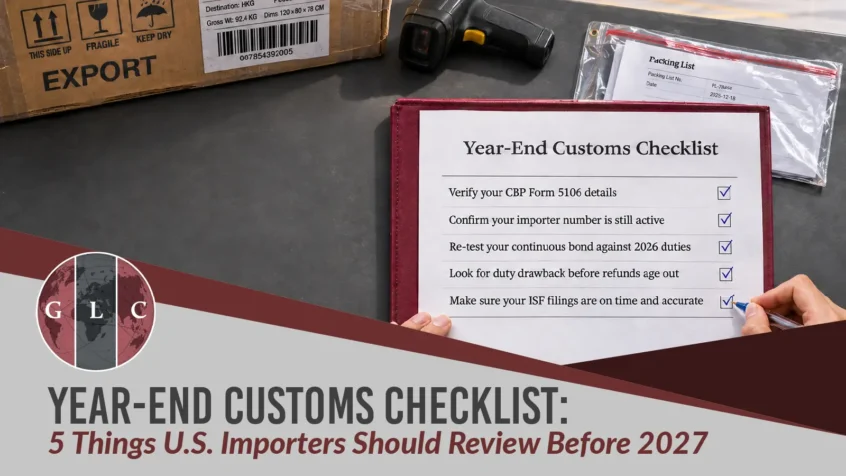
Why your year-end customs review matters more this year
In 2026, a customs account that was fine in January can block your cargo in December. CBP now voids importer numbers over bad data, deactivates dormant accounts automatically, and checks bonds against this year’s duty totals.
Three changes drive this. Since September 18, 2026, CBP can immediately void an importer of record (IOR) number when the information on CBP Form 5106 is inaccurate or incomplete. Since July 16, ACE automatically deactivates IOR accounts that have not filed an entry in 366 days.
New duties also arrived in 2026. Section 301 duties of 10% or 12.5% on imports from 60 economies took effect July 24, and higher duties can push up the bond you need.
The five checks below take little time with your customs broker. Each one protects your ability to clear cargo, or recovers money you have already paid.
Check 1: Verify your CBP Form 5106 details
CBP Form 5106 is the record that creates your importer of record number, and since September 18, 2026, an error on it can void that number. A voided number is invalid for any purpose, including entering merchandise into the United States.
This is already happening. In early November, CBP sent letters warning numerous importers that their numbers could be voided. The cutoff was entries filed from 12:01 a.m. ET on November 18, unless they fixed their Form 5106 data. CBP emails voiding notices to the most recent email address on file, so an outdated email means you may hear about it late.
CBP expects every detail to belong to your company, not to a third party:
- Physical address: your actual place of business. Not a broker’s or forwarder’s office, a registered agent, a virtual office or a P.O. box.
- Email and phone: your own. A broker, consultant or forwarder may not substitute theirs.
- Legal name and EIN: matching your current corporate records.
- Power of attorney: signed directly between your company and your customs broker, not through a forwarder.
What to do before January: ask your broker for the Form 5106 record currently on file, or pull it from the ACE portal. Compare each field to your corporate records, then correct anything outdated. Repeat the review after any merger, move, ownership change or new EIN.
Inaccurate certifications can also create legal liability beyond a voided number. We covered CBP’s Form 5106 standards in more depth in CBP Import Compliance: IOR Enforcement and Supply Chain.
Check 2: Confirm your importer number is still active
If your company has not filed an entry in the last 366 days, your importer number may already be inactive. Since July 16, 2026, ACE deactivates these accounts automatically under 19 CFR 24.5(e).
The scale is large. ArentFox Schiff, citing recent reports, says CBP deactivated about 5.3 million IOR numbers between June 30 and September 10, 2026. Only 599 had been reactivated by September 10.
An “Inactive for Entry Purposes” number cannot be used for cargo release or entry summary filings. It can still be used to file ISF, file drawback, act as consignee and secure a bond. That means a shipment can sail with its ISF accepted, and the problem only shows up when your broker files the entry.
This check matters most if you:
- Import seasonally, or only a few times a year
- Hold separate importer numbers for a subsidiary, division or new entity
- Paused imports in 2025 or 2026 and plan to restart
What to do before January: list every importer number your company uses and check each status in the ACE portal, or ask your broker. To reactivate, an ABI broker submits a transaction that changes the status from “20-Inactive” to “10-Active,” with complete Form 5106 data. That is why Checks 1 and 2 go together: reactivation needs an accurate record.
Check 3: Re-test your continuous bond against 2026 duties
If your duties went up this year, your continuous bond may no longer be large enough, even if your shipment volume stayed flat. CBP generally sets the bond at the greater of $50,000 or 10% of the duties, taxes and fees you paid over the previous 12 months.
The amount also rounds up. Under CBP’s 2024 bond guidance, bonds move in $10,000 steps up to $100,000, then in $100,000 steps. For example, $1.2 million in duties, taxes and fees means a 10% figure of $120,000, so the required bond becomes $200,000.
CBP reviews sufficiency on a rolling 12-month basis and can demand a larger bond before your renewal date. Its regulation gives the principal 15 days from written notice to fix a deficiency. CBP counted 27,479 bond insufficiencies worth almost $3.6 billion in fiscal 2025, the most on record, according to CBP data reported by CNBC.
A larger bond is not always quick to get. Sureties may ask for financial statements, and some require collateral such as a letter of credit.
What to do before January:
- Pull your duties, taxes and fees for the last 12 months from ACE or your broker’s monthly statements.
- Apply the 10% formula and the rounding, then compare the result with your current bond.
- Estimate 2027 duties under the rates now in effect, including the Section 301 duties that took effect July 24, 2026.
- If you are close to the limit, raise the bond on your own schedule and loop in finance early.
Check 4: Look for duty drawback before refunds age out
If you exported or destroyed goods that you imported, you may be able to recover up to 99% of the duties, taxes and fees paid on them. That refund is called duty drawback, and the clock is running: a complete claim must be filed within 5 years of the importation date.
The main types are:
- Unused merchandise: you re-export imported goods without using them. Substitution can apply when the exported goods share the same 8-digit tariff classification.
- Manufacturing: you import components, build a product in the U.S. and export it.
- Rejected merchandise: you return goods that were defective or did not match the order.
Several 2026 duties qualify. According to Alliance Drawback Services, Section 301 duties are recoverable, including the forced-labor duties in effect since July 24, 2026. The Section 122 surcharge collected earlier in 2026 was eligible too. Antidumping and countervailing duties are not, and Section 232 eligibility depends on the product.
A quick example: if you paid $500,000 in eligible duties on goods and later exported 20% of them, the potential refund is about $99,000. That is 99% of $100,000.
What to do before January: list your exports and destructions from the past five years and match them to import entries. Imports from late 2021 are aging out now, and early-2022 entries follow in the first months of 2027. An inactive importer number does not block drawback filing, so even dormant accounts can claim.
Check 5: Make sure your ISF filings are on time and accurate
Every ocean shipment to the U.S. starts with an Importer Security Filing, and a late or wrong one can cost you before the cargo arrives. CBP can assess liquidated damages of $5,000 per violation for a late, inaccurate or incomplete ISF.
Core ISF data is due no later than 24 hours before the cargo is loaded at the foreign port. That data includes the seller, buyer, importer and consignee numbers, manufacturer, ship-to party, country of origin and HTS number. The container stuffing location and consolidator can follow, but no later than 24 hours before the vessel arrives in the U.S.
Most ISF problems start upstream. A supplier changes, a factory ships from a different location, or the HTS number on the ISF does not match the one on the entry. An ISF also needs a bond behind it, such as your continuous importation bond or a dedicated ISF bond, so Check 3 matters here too.
What to do before January:
- Pull a sample of your 2026 ocean shipments and confirm each ISF was filed on time.
- Compare each ISF with its entry: the manufacturer, country of origin and HTS number should match.
- Agree in writing who files your ISF (you, your broker or your forwarder) and how supplier data reaches them.
- Set an internal cutoff a few days before the 24-hour deadline, and give suppliers a fast way to send updates.
For more on preparing entries before cargo reaches the U.S., read Customs Clearance Starts Before Arrival.
Your year-end checklist at a glance
Use this table as the agenda for a year-end review with your customs broker.
| Check | Why it matters now | Do this before January |
|---|---|---|
| 1Form 5106 details | CBP has voided importer numbers over inaccurate data since September 18, 2026 | Pull your record; fix the address, email, phone, legal name and EIN; confirm your power of attorney |
| 2Importer number status | ACE deactivates numbers with no entry filed in 366 days | Check every importer number in ACE; reactivate before your next booking |
| 3Continuous bond | The bond must cover 10% of your last 12 months of duties, taxes and fees ($50,000 minimum) | Recalculate with 2026 duties; raise the bond before CBP asks |
| 4Duty drawback | Claims must be filed within 5 years of the import date | Match exports and destructions to import entries; file before entries age out |
| 5ISF accuracy | ISF is due 24 hours before loading; each late or inaccurate filing can cost $5,000 | Compare a sample of 2026 ISFs with their entries; set supplier cutoffs |
How GLC’s customs brokerage team can help
GLC’s licensed in-house customs brokers can work through all five checks with you in one year-end review. Here is how our customs brokerage services map to each check:
- Importer record and status: we review the Form 5106 data on file with you, then submit updates or a reactivation request when needed.
- Bonds: continuous bond management, single-entry bond coordination and duty-payment planning support.
- Duty drawback: drawback entry filing, from matching exports to imports through the claim.
- ISF and entries: Importer Security Filing, import entry processing, classification support and Partner Government Agency coordination.
- Visibility: periodic monthly statements, customized entry reporting, automated entry and release notifications, and customs document visibility in our Neo Portal.
Need a second set of eyes on your customs account before 2027? Request customs brokerage support from Global Logistical Connections.
This article is general information, not legal advice. Final determinations on classification, duties, bonds and drawback eligibility rest with U.S. Customs and Border Protection and other agencies.