
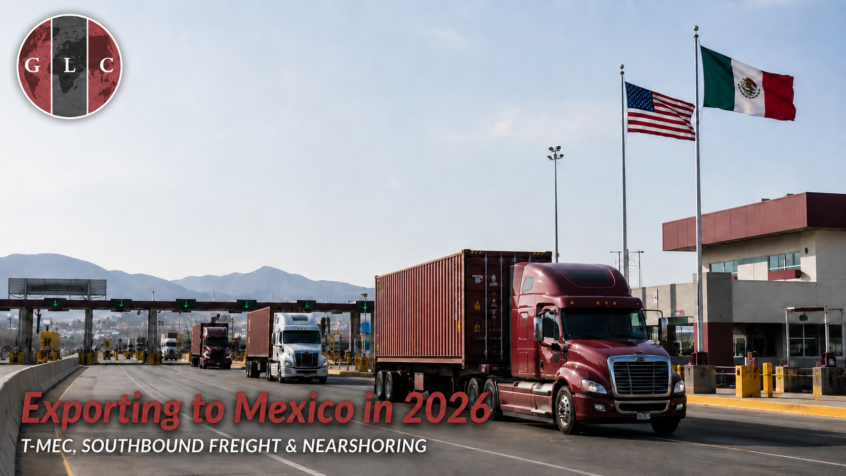
Mexico remains one of the most important markets for North American supply chains. For U.S. and Canadian companies, exporting to Mexico in 2026 is closely tied to regional manufacturing, cross-border trucking, customs compliance, and the evolving T-MEC/USMCA environment.
But moving cargo southbound requires more than booking a truck. Exporters need to understand rules of origin, Mexican customs documentation, tariff classification, transportation requirements, and the operational impact of the 2026 USMCA review before freight reaches the border.
Nearshoring adds another layer. As companies expand or support manufacturing in Mexico, the movement of machinery, components, raw materials, packaging, and finished goods is creating more frequent two-way freight flows across North America. The companies that coordinate compliance and logistics early are better positioned to keep those flows predictable.
T-MEC Remains in Force, but the 2026 Review Matters
The United States, Mexico, and Canada conducted the required joint review of the USMCA on July 1, 2026. The United States did not agree to renew the agreement in its current form, but that decision did not terminate the agreement. Current T-MEC/USMCA provisions continue to govern North American trade while the review process and negotiations continue. Exporters can consult the official USMCA agreement and its governing chapters directly through the Office of the U.S. Trade Representative.
The negotiations are important because U.S.-Mexico discussions in 2026 have focused on issues including rules of origin, automobiles, steel and aluminum, economic security, labor, agriculture, and regional manufacturing. The July round also emphasized strengthening North American manufacturing and regional supply chains, with another U.S.-Mexico negotiating round expected in September 2026.
For importers, exporters, and manufacturers that want a broader planning perspective, GLC has also outlined the operational implications in its USMCA 2026 Review supply chain update. The practical takeaway is to continue following the rules currently in force while maintaining flexibility for future changes.
T-MEC Origin Is About the Product, Not Just Where It Ships From
A shipment does not automatically qualify for preferential T-MEC treatment simply because it leaves the United States or Canada. The product itself must meet the applicable origin requirements.
The USMCA Chapter 4 Rules of Origin establish how a good can qualify as originating. Depending on the commodity, qualification may depend on whether the good is wholly obtained or produced in North America, whether non-originating inputs satisfy a product-specific tariff shift, whether regional value content thresholds are met, or whether other product-specific requirements apply.
For qualifying shipments into Mexico, the certification of origin does not require a prescribed government form. The importer, exporter, or producer may prepare the certification, but it must contain the agreement’s nine minimum data elements. Mexican authorities can also conduct origin verifications, so exporters should be able to support claims with supplier declarations, bills of material, product classifications, production records, and other relevant documentation.
Companies with complex North American sourcing should connect origin analysis with broader GLC Supply Chain Consulting planning. Origin eligibility, sourcing decisions, routing, landed cost, and inventory strategy should be evaluated together rather than as separate decisions.
Southbound Freight Starts With Customs Data
Transportation planning and customs planning should happen together. Mexico requires a customs declaration, or pedimento, for commercial crossings. Supporting documentation generally includes the commercial invoice, bill of lading, and documents demonstrating compliance with applicable Mexican regulations and preferential origin requirements. Mexican importers must also meet importer-registration requirements.
Classification is another critical step. Exporters should confirm the Mexican tariff line and applicable NICO rather than simply reusing a U.S. HTS classification. A classification mismatch can affect duties, permits, non-tariff requirements, and the information transmitted at customs.
Mexico has also strengthened customs-value controls. The electronic Manifestación de Valor through Mexico’s VUCEM Single Window connects declared customs value with supporting information such as applicable adjustments, freight, insurance, Incoterms, contracts, and payment documentation.
VUCEM originally announced mandatory electronic transmission beginning December 9, 2025; after a subsequent extension, the U.S. Commercial Service reported mandatory enforcement beginning June 1, 2026. In 2026, exporters should make sure the commercial documents provided to their Mexican customer align with the value information used for customs clearance.
For road movements within Mexico, the Complemento Carta Porte also provides detailed information about the carrier, goods, origin, and destination. The operational lesson is simple: documentation should be reviewed before dispatch, not after the truck arrives at the border.
For companies managing recurring cross-border shipments, GLC’s freight forwarding services can support transportation planning, routing, shipment visibility, and coordination across multiple modes. GLC also provides trucking services for ground transportation requirements and first-mile or final-mile connections.
For a quick visual overview of how transportation mode selection affects international shipments, watch GLC’s YouTube video, The Road to Global Markets: Understanding U.S. Export Dynamics. It provides useful context for evaluating air, ocean, and land options as part of a broader export strategy.
Nearshoring Is Creating More Two-Way Freight
Nearshoring is often described as manufacturing moving closer to the U.S. market, but its logistics impact is broader. A factory in Mexico may depend on machinery from the United States, components from North American suppliers, packaging from another facility, and recurring replenishment shipments. Intermediate or finished goods may then move north again.
Banco de México data show that 9.1% of globally integrated manufacturing companies with more than 100 employees reported that nearshoring contributed to higher production, sales, or investment during the July 2024-June 2025 period. That figure illustrates how relocation continues to influence manufacturing activity even as companies adjust investment plans to changing trade conditions.
For logistics teams, this can translate into higher shipment frequency, tighter production windows, and greater pressure on border coordination. Businesses building or supporting Mexican production should evaluate transportation capacity, inventory positioning, supplier schedules, and contingency plans through an integrated North American network. GLC’s Mexico logistics operation supports freight forwarding, customs brokerage, air freight, warehousing, and supply chain coordination in the Mexican market.
A 2026 Export-to-Mexico Checklist
• Confirm the Mexican tariff classification and applicable NICO before shipment.
• Determine whether the product qualifies for T-MEC preferential treatment and retain documentation supporting origin.
• Verify that the certification of origin includes all required data elements when preferential treatment will be claimed.
• Align the commercial invoice, Incoterms, payment information, and valuation support with the Mexican importer before dispatch.
• Confirm whether NOMs, permits, sector registrations, or other non-tariff requirements apply to the product.
• Establish responsibilities for customs clearance, duties, transportation, and final delivery in the commercial terms.
• Plan border crossings, carrier handoffs, and Mexican domestic transportation as one coordinated transportation strategy.
Turning Nearshoring Into a Logistics Advantage
Nearshoring shortens geographic distance, but it does not automatically simplify logistics. Exporting to Mexico in 2026 requires accurate origin documentation, consistent customs data, reliable southbound freight capacity, and clear visibility across border handoffs.
GLC combines international freight forwarding, air freight, ocean freight, trucking, customs expertise, and supply chain planning to help businesses connect North American trade lanes more effectively. For companies evaluating southbound transportation, manufacturing support, or cross-border expansion, GLC Mexico provides a direct connection to logistics resources in the market.
For companies exporting to Mexico in 2026, the opportunity is significant. The businesses best positioned to capture it will be those that treat T-MEC compliance, customs documentation, transportation planning, and nearshoring strategy as one coordinated supply chain process.